Introduction
Most first aid kits fall into two categories. You either get a cheap bag stuffed with drugstore bandages that falls apart after one season, or you spend hours researching person components and trying to build something yourself.
Both approaches waste your time and money.
My Medic offers a third option. They build pre-configured kits designed by first responders and emergency professionals.
Each kit addresses specific scenarios, from solo hiking trips to family bug-out plans to serious trauma situations.
The company manufactures several distinct product lines. Understanding which one matches your needs matters more than picking the most expensive option.
You can easily overspend on capacity you never use or buy too small and find yourself scrambling to add items later.
This my medic review breaks down each major kit type, examines real-world performance, and addresses the biggest concern everyone has about these products. Does the premium price deliver premium value?
Features Overview
The MYFAK Series
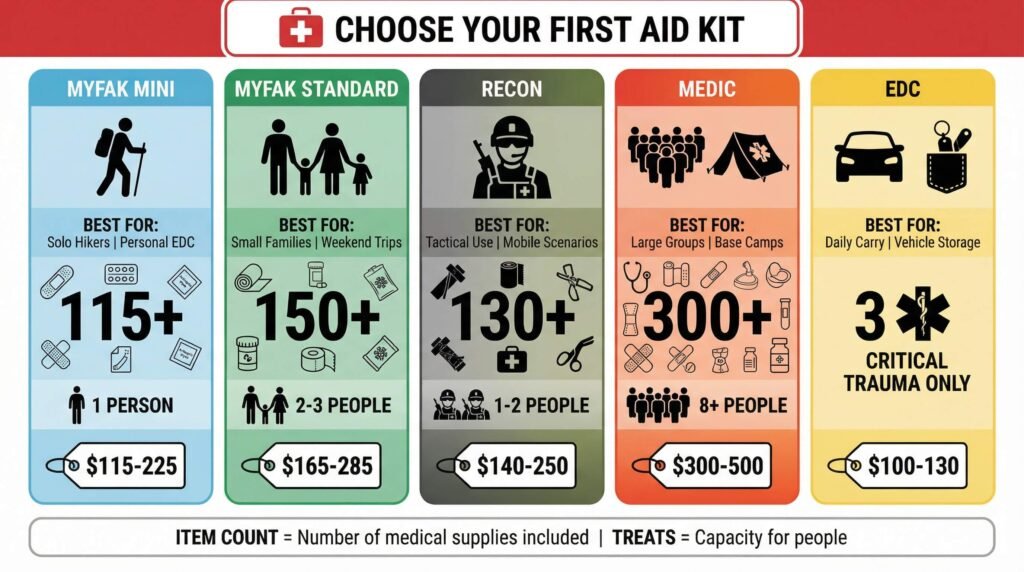
The MYFAK line represents their most popular offering. These kits come in three sizes: Mini, Standard, and Large.
The Mini contains 115+ items. The Standard packs 150+ pieces.
The Large version includes 200+ supplies depending on configuration.
Every kit uses their modular MOD system, which organizes supplies by category.
When you open a MYFAK, it unfolds like pages in a book. Each section contains related items: wound care in one MOD, burn treatment in another, medications separate, tools and instruments in their own compartment.
You see everything at once without dumping the entire bag on the ground.
Each kit comes in two versions. The Basic version handles common medical scenarios like cuts, burns, sprains, and basic emergencies.
The Pro version adds trauma-specific gear including chest seals for penetrating wounds, a tourniquet for severe bleeding, hemostatic powder, and extra advanced supplies.
The exterior uses ballistics-grade nylon construction. The case resists water without being fully waterproof.
Zippers hold up to repeated use.
MOLLE webbing on the outside lets you attach the kit to other gear.
The Recon Kit
The Recon prioritizes portability and quick access. This kit features padded back panels, stowable shoulder straps with seatbelt-style webbing, and many quick-access pockets.
You can wear it as a hip pack, sling it over your shoulder, or attach it to tactical gear. The design targets people who move fast and need medical supplies that move with them.
The Recon Pro version treats one to two people for life-threatening injuries. Basic version handles common medical situations for small groups.
The Medic Kit
This represents their largest capacity option. The Medic treats eight or more people with various injuries.
Companies, serious preppers, and group organizers typically choose this size.
The Pro version focuses on three to four people for life-threatening trauma. The sheer volume of supplies means you can handle many casualties or extended situations without resupply.
Specialized Options
The TFAK (Trauma First Aid Kit) only comes in Pro configuration. This kit specializes exclusively in treating gunshot wounds and severe trauma.
Range officers, security professionals, and people in high-threat environments choose this option.
The Everyday Carry (EDC) strips everything down to three life-saving essentials: a vented chest seal, RATS tourniquet, and compressed gauze. This fits in a jacket pocket or glove compartment.
The EDC addresses the most critical trauma scenarios without bulk.
What Comes With Every Kit
All My Medic kits include access to their M.A.R.C.H training course. This covers Massive Bleeding, Airway, Respiration, Circulation, and Hypothermia management.
The training teaches you proper triage and treatment priorities during multi-casualty situations.
The kits also qualify for HSA/FSA purchase, which reduces your actual out-of-pocket cost if you have those accounts. They manufacture everything in the USA and back each kit with a lifetime guarantee.
Performance Analysis
Real-World Durability
I have taken my MYFAK on probably a dozen camping trips over two years. The exterior shows some scuffing but zero structural damage.
The zippers still operate smoothly.
The velcro securing each MOD holds strong.
Other users report similar experiences. These cases withstand being tossed in truck beds, strapped to backpacks, and stored in varying temperatures without degradation.
The materials feel substantial in your hands. You can tell the difference immediately when comparing to cheaper choices.
The stitching uses reinforced seams at stress points.
The webbing handles repeated attachment and removal.
Organization System Performance
The MOD system delivers exactly what My Medic claims. During a camping incident where a friend suffered a deep laceration from a knife, I opened the kit and immediately located the wound closure supplies without searching.
The page-fold design means every section stays visible. You flip through MODs like reading a book.
Each pouch uses clear labeling.
Even someone unfamiliar with the kit can find specific items quickly.
This design choice saves critical time during emergencies. Stress makes people forget things and fumble with equipment.
When everything sits in plain view with clear organization, you spend less time searching and more time treating.
Supply Quality
The components inside these kits match what professionals use. The hemostatic gauze for controlling serious bleeding uses Quikclot technology.
The chest seals come from established medical suppliers.
The tourniquet allows one-handed application.
I compared the bandages, tape, and basic supplies to drugstore equivalents. The My Medic versions use thicker materials, better adhesives, and more durable packaging.
Small details like individually wrapped supplies prevent contamination and waste.
The medications include a useful variety. Pain relievers, antihistamines, electrolyte packets, and altitude sickness medication cover common situations.
The quantities actually make sense for extended trips as opposed to single-use token amounts.
Training Value
The included M.A.R.C.H training course adds genuine value. Medical supplies only work if you know how and when to use them.
The course teaches treatment priorities. You learn to address life-threatening bleeding before worrying about minor cuts.
You understand when to use a tourniquet versus pressure bandages.
The training covers basic airway management and signs of shock.
This education separates a useful kit from an expensive collection of items you fumble with during emergencies. You gain confidence in your ability to respond appropriately.
Pros and Cons
What Works Really Well
The modular customization capability stands out immediately. You can remove MODs you do not need and add components specific to your activities.
Someone focused on hunting might swap out certain supplies for items addressing field injuries.
A family camping kit needs different medications than a solo backpacking setup.
The quality components justify their inclusion. When you examine each item, you understand why My Medic selected it.
The trauma shears cut through thick materials.
The bandages use proper adhesives. The chest seals come from established medical manufacturers.
Durability eliminates the replacement cycle. You buy this kit once and use it for years.
The exterior construction, quality zippers, and reinforced stress points mean the case outlasts the supplies inside.
The lifetime guarantee backs their confidence in the product. If something fails because of manufacturing defects, they replace it.
This reduces long-term cost concerns.
Made in USA manufacturing matters to many buyers. You know the supply chain. You support domestic production.
Quality control happens under stricter standards.
Where Problems Appear
The upfront cost creates real hesitation. A MYFAK Mini Pro runs around $225.
The standard version approaches $200-$300 depending on configuration.
These prices shock people comparing them to $30 drugstore kits.
The expense makes sense when you break down component costs, but the psychological barrier stays real. Many people starting their preparedness path lack the budget for premium equipment.
Splinting supplies need improvement. The kits include basic materials for stabilizing fractures, but serious bone injuries require better options.
You may need to supplement with SAM splints or similar products.
The paracord quality does not match the standard set by everything else in the kit. This seems like a minor detail, but when every other component uses premium materials, subpar cordage stands out.
Weight becomes noticeable in larger kits. The MYFAK Standard adds several pounds to your pack.
If you prioritize ultralight backpacking, this creates tension between preparedness and mobility.
The medical guide only exists as a digital download. You need your phone charged and accessible to reference it.
A printed quick reference card would improve field usability.
Larger kits can overwhelm new users. Opening a kit with 200+ items during an emergency might cause more confusion than help if you lack training.
This emphasizes the importance of practicing with your specific kit before you need it.
User Experience
People who buy My Medic kits use them. That sounds obvious, but many first aid kits sit unopened in closets.
These kits get taken on trips, stored in vehicles, and kept accessible at home.
The feedback from users with medical backgrounds carries extra weight. ER nurses, EMTs, and military medics consistently praise the supply selection and organization.
These professionals recognize quality components and proper trauma response equipment.
Outdoor enthusiasts mention specific use cases often. Treating burns from camp stoves, managing blisters on long hikes, addressing dehydration with electrolyte packets, and dealing with allergic reactions appear regularly in reviews.
The training component changes how people view the kit. Instead of just owning medical supplies, they gain confidence in their ability to respond during emergencies.
This psychological shift from “I hope I never need this” to “I know what to do if something happens” represents real value.
One consistent pattern emerges across reviews. People wish they had purchased My Medic sooner as opposed to wasting money on cheaper kits that disappointed them.
The higher initial cost avoids the replacement and supplementation cycle.
Check Current Pricing on MYFAK Kits
Value for Money
This my medic review must address the elephant in the room. These kits cost substantially more than choices.
You need to understand if that premium pricing delivers actual value or just fancy marketing.
Breaking down component costs helps clarify the value proposition. A quality tourniquet alone costs $25-30.
Chest seals run $25-35 each.
Hemostatic gauze adds another $15-20. Trauma shears cost $10-15 for good ones.
You quickly reach $100+ buying just the trauma essentials individually.
The MYFAK Mini Pro at $225 includes all those items plus 100+ extra supplies, professional organization, durable case, and training access. When viewed component-by-component, the pricing becomes defensible.
Comparing to drugstore kits reveals the quality gap. A $30 general first aid kit contains maybe 40 items.
Most are single-use packets, basic bandages, and cheap tools.
The supplies handle minor scrapes but fall apart during serious situations. You replace it every year or two because the case breaks or supplies degrade.
The cost-per-person calculation changes the math for groups. A MYFAK Standard treating 2-3 people costs roughly $250-300.
That works out to $80-150 per person for comprehensive medical coverage.
A family spending $50 each on person drugstore kits gets inferior supplies and no organization system.
The lifetime guarantee and durability extend the value timeline. You buy a My Medic kit once and use it for a decade or longer.
The case lasts.
You replace person supplies as needed. A $200 kit used for ten years costs $20 annually.
HSA/FSA eligibility reduces actual out-of-pocket expense. If you can purchase with tax-advantaged healthcare dollars, the effective cost drops significantly.
The training included with each kit adds value you cannot easily quantify. How much is knowing how to properly respond during a medical emergency worth?
That education stays with you beyond just this specific product.
For casual users who rarely venture outdoors and want basic supplies “just in case,” the value proposition weakens. You probably do not need trauma supplies for chest wounds and severe bleeding if you spend weekends at home.
A cheaper general kit might serve you fine.
For outdoor enthusiasts, preppers, hunters, campers, and anyone serious about self-reliance, the value becomes obvious. You need reliable equipment organized for quick access.
The alternative is building your own kit piece by piece, which takes substantial research time and often costs more.
View the Complete MYFAK Series
Final Verdict
After extensive testing and comparison, this my medic review concludes that these kits deliver professional-quality medical supplies organized for real-world emergency response. The premium pricing reflects premium components, not marketing fluff.
You should buy a My Medic kit if you regularly spend time outdoors, take emergency preparedness seriously, value quality over lowest price, and want professional-grade supplies without researching and assembling everything yourself.
You should skip these kits if you need absolute minimum cost, rarely leave urban areas, lack budget for $150+ investment, or only want basic bandages for minor home injuries.
The specific kit you choose matters as much as the decision to buy. The MYFAK Mini suits solo hikers and people with storage constraints.
The Standard MYFAK works for small families and regular outdoor activities.
The Recon fits tactical applications and mobile scenarios. The Medic handles large groups and base camp situations.
The EDC provides critical trauma supplies in minimal space.
My personal recommendation starts with the MYFAK Mini Pro for most people. You get trauma supplies, comprehensive basic medical items, proven organization system, and durable construction at the entry-level price point.
If that serves your needs well, you can always expand to larger kits later.
The training access alone makes these kits worthwhile. Medical equipment only helps if you know how to use it.
The M.A.R.C.H course teaches proper priorities and response procedures that apply beyond just this specific product.
The modular system means you buy once and customize forever. You swap components as needs change.
You restock person items without replacing the entire kit.
This flexibility extends the useful life and maintains value over time.
These kits represent genuine investment in preparedness as opposed to cheap peace of mind. You pay more upfront but receive professional-quality equipment that performs during actual emergencies.
That difference matters when seconds count and proper supplies save lives.
Shop All My Medic Kits and Find Your Perfect Match
The choice ultimately depends on how seriously you take emergency preparedness and what situations you realistically face. A comprehensive my medic review thanks these kits cost more because they deliver more.
If that trade-off aligns with your priorities and budget, you will not regret the purchase. If you need something basic and inexpensive, be honest about that and choose accordingly.